Skip to content

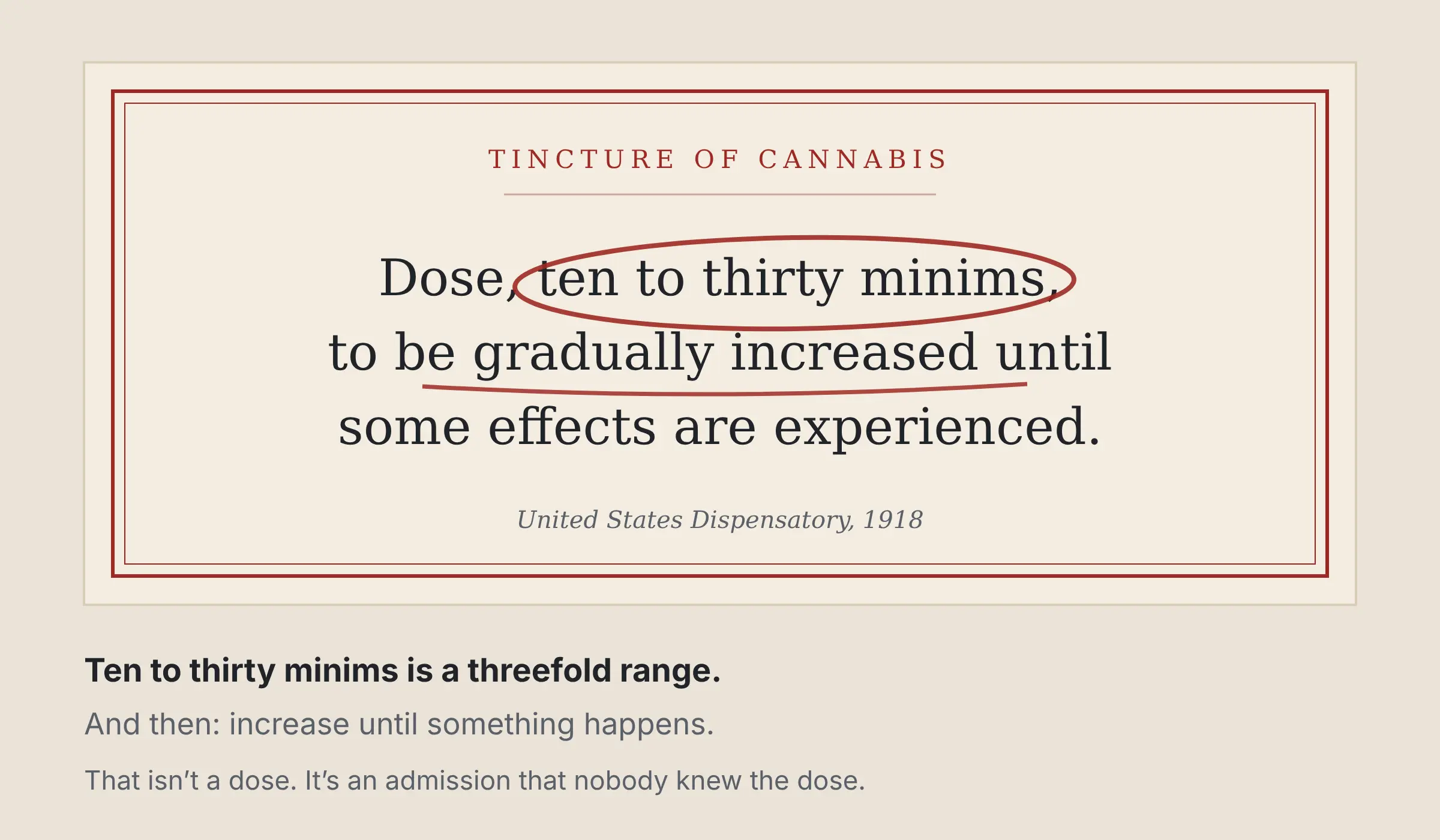
Open a pharmacy reference from 1918 and look up the dose of cannabis tincture. Here is what you find:
“Dose, ten to thirty minims (0.6–1.8 mils), to be gradually increased until some effects are experienced.”
Read that again, because two things are wrong with it as a dose.
The first is the range. Ten to thirty minims is a threefold spread. Imagine a paracetamol box telling you to take between one tablet and three.
The second is the instruction that follows. Gradually increased until some effects are experienced. That is not a dose at all. It is an admission, politely worded, that nobody knew the dose — and an instruction to find it by trial, on the patient.
Eli Lilly’s own handbook for physicians used almost identical language for its cannabis preparations: start low, and increase until the desired effect is produced.
This wasn’t carelessness. It followed inevitably from a problem we covered in our article on what was actually in a bottle of cannabis medicine: until 1940 nobody could measure what was in it. And if you cannot know a batch’s strength, you cannot print a number. The only honest thing left to say is work it out as you go.
What follows is how the profession lived with that for a hundred years — and what, exactly, changed.
1. The Instruction, in Four Versions
The titration instruction shows up wherever cannabis was dosed, phrased slightly differently each time.
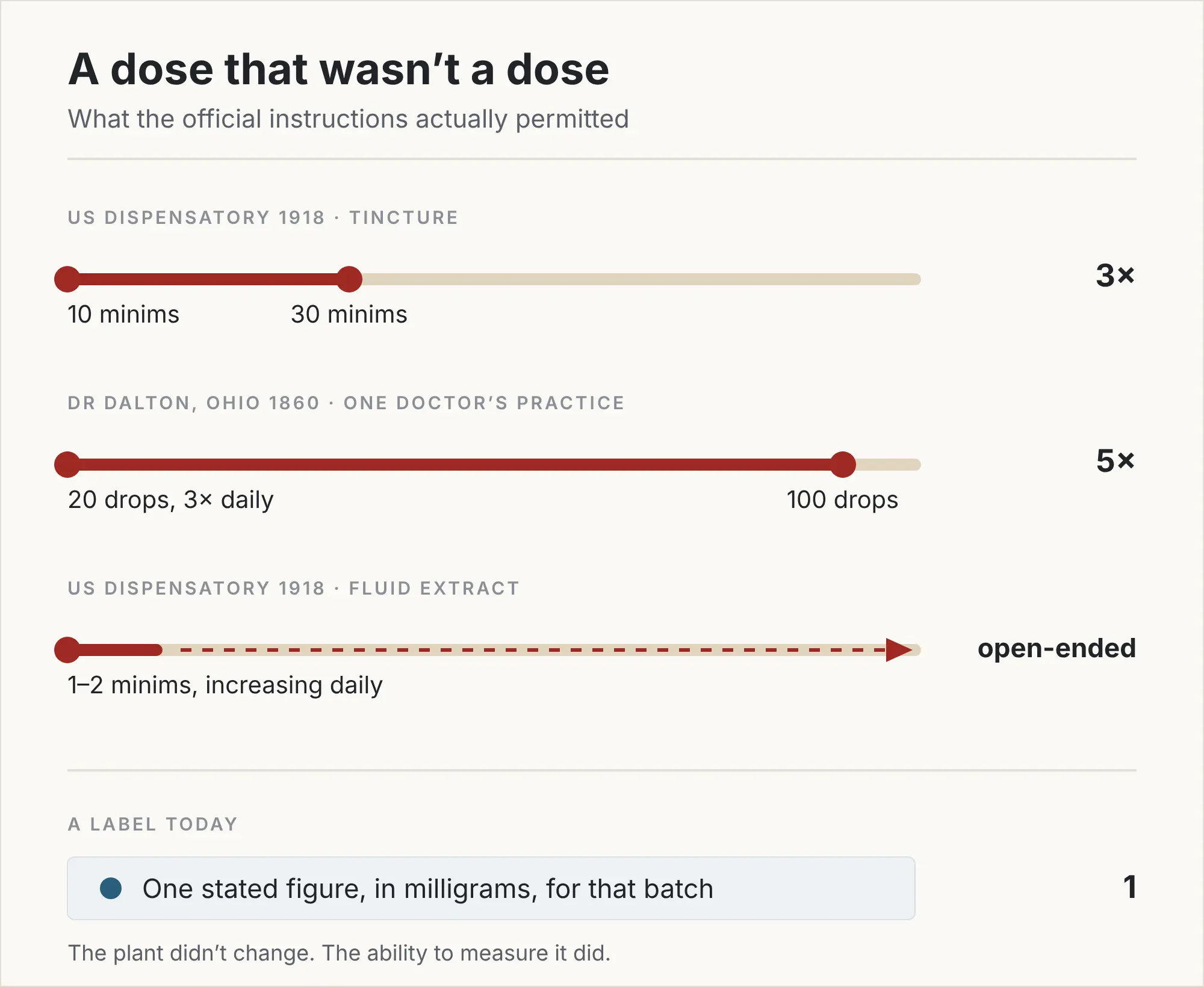
The 1918 United States Dispensatory on the fluid extract advised starting with one or two minims and increasing daily until some effect was obtained. On the tincture, ten to thirty minims, gradually increased.
In Dublin in 1851, Michael Donovan of the Apothecaries’ Hall put it more fully than anyone:
“The most prudent mode of proceeding is to begin with a small dose, and slowly increase it night, noon and morning, until the pain give way, or until it be proved that it will not give way, even when the sensorium becomes affected.”
That’s a complete clinical protocol in one sentence. Start small. Increase on a fixed schedule. Stop when the pain goes — or when it’s clear it won’t, and the patient is getting woolly instead.
And in Ohio in 1860, a state medical committee collected prescribing habits from physicians across the country. Dr Buckingham gave one or two grains every hour until the pain was relieved. Dr Dalton started patients at twenty drops of tincture three times daily and worked up to a hundred.
Twenty drops to a hundred drops. A fivefold range, inside one doctor’s practice.
2. Why They Had No Choice
The reason is in that Ohio report too, stated more bluntly than most period sources manage.
The committee’s chairman, Dr R. R. McMeens, wrote:
“To the impurity of the hemp, is to be attributed the diversity of opinion as to its operation and benefit in disease.”
In other words: doctors disagreed about whether cannabis worked because they were not all using the same thing. One physician’s success and another’s failure might both be accurate reports — of two different substances sharing a label.
Buckingham put the same point in practical terms. The activity of the medicine, he said, depended very much upon the parcel from which it was taken.
The parcel. Not the plant, not the preparation, not the dose — the particular batch that happened to arrive.
This is the thread running through this whole series. The 1918 Dispensatory, writing sixty years later, had not moved on: commercial samples varied so greatly in power, it said, that it was impossible to assign the proper dose. The closest thing to a strength test anyone had was the dog assay, which the profession itself admitted was inadequate.
3. Dublin Got There First
The Irish contribution to this story is bigger than it looks, and it is almost entirely forgotten.
William Brooke O’Shaughnessy, born in Limerick, published his Calcutta cannabis research in 1839. Within six years it had reached Dublin, and Dublin did something useful with it: it identified the dosing problem and proposed the solution still in use today.
Sir Dominic Corrigan, writing in the Dublin Hospital Gazette in 1845, was explicit about where the difficulty lay:
“While the Indian hemp has much to recommend it, there are circumstances connected with it that require to be well borne in mind. The first of these is its very variable effects on different individuals.”
Note what Corrigan is describing. Not batch variability — person variability. The same preparation, the same dose, different people, different results. That is a separate problem from the one McMeens identified, and it is the one that has never gone away.
Donovan, meanwhile, had run into batch variability directly. He tested hemp available locally in Ireland and found it weak; his clinical results improved markedly once he was working with material supplied by O’Shaughnessy himself.
He also experimented on himself, treating his own leg pain, and left one of the more memorable descriptions in the literature — walking without much consciousness of the motion of his legs, feeling as though they did not belong to him.
So by 1851, Dublin had established three things: preparations differ, people differ, and the only safe response is to start small and climb slowly. There is more on Ireland’s long and strange relationship with this plant here.
The measurement problem would take another ninety years to solve. The dosing advice was already right.
4. When the Standard Itself Moved
Here is the detail that makes the whole picture clear.
The US Dispensatory, describing the official tincture, notes almost in passing that the strength of the current preparation is about 33 per cent less than the 1890 tincture.
Sit with that for a second.
Not a bad batch. Not a dodgy supplier. The official standard definition of tincture of cannabis — the one every pharmacy in the country was meant to dispense against — had shifted by a third between editions of the reference book.
A doctor who learned to prescribe in 1890 and was still practising in 1918 would have been writing the same number on a prescription for a preparation a third weaker, unless he happened to notice the footnote.
That is what a world without measurement looks like. Not chaos exactly. Just a slow, quiet drift in what words mean.
5. A Note on the Units, Which Didn’t Help
Period dosing used measures that were themselves approximate.
A minim is one-sixtieth of a fluid drachm — roughly 0.06 ml. It was defined as about one drop of water.
But cannabis preparations were alcoholic, and a drop of alcoholic liquid is smaller than a drop of water. So “twenty drops” and “twenty minims” were not the same quantity, and whether a given physician meant one or the other was frequently unclear.
A grain is 64.8 mg, used for the solid extract.
So the typical prescription combined an imprecise unit, a threefold or fivefold permitted range, an unmeasurable active content, an official standard that had moved by a third, and the instruction to increase until something happened.
Against all of that, Donovan’s night-noon-and-morning protocol starts to look like the most rigorous thing in the room.
6. What Survived, and What Actually Changed
Start low and build up slowly is still the standard advice with CBD today. Any honest brand will tell you the same thing Donovan wrote in 1851.
So it would be easy to conclude that nothing has changed in a hundred and seventy years. That isn’t right, and the difference matters.
Corrigan’s problem — people respond differently — is real and permanent. No technology fixes that. It is why titration still exists.
McMeens’s problem — you don’t know what’s in the bottle — was a technology problem, and it has been solved. High-performance liquid chromatography separates the cannabinoids in a sample and reports each as a measured quantity in milligrams per millilitre, for a specific batch, on a certificate you can read.
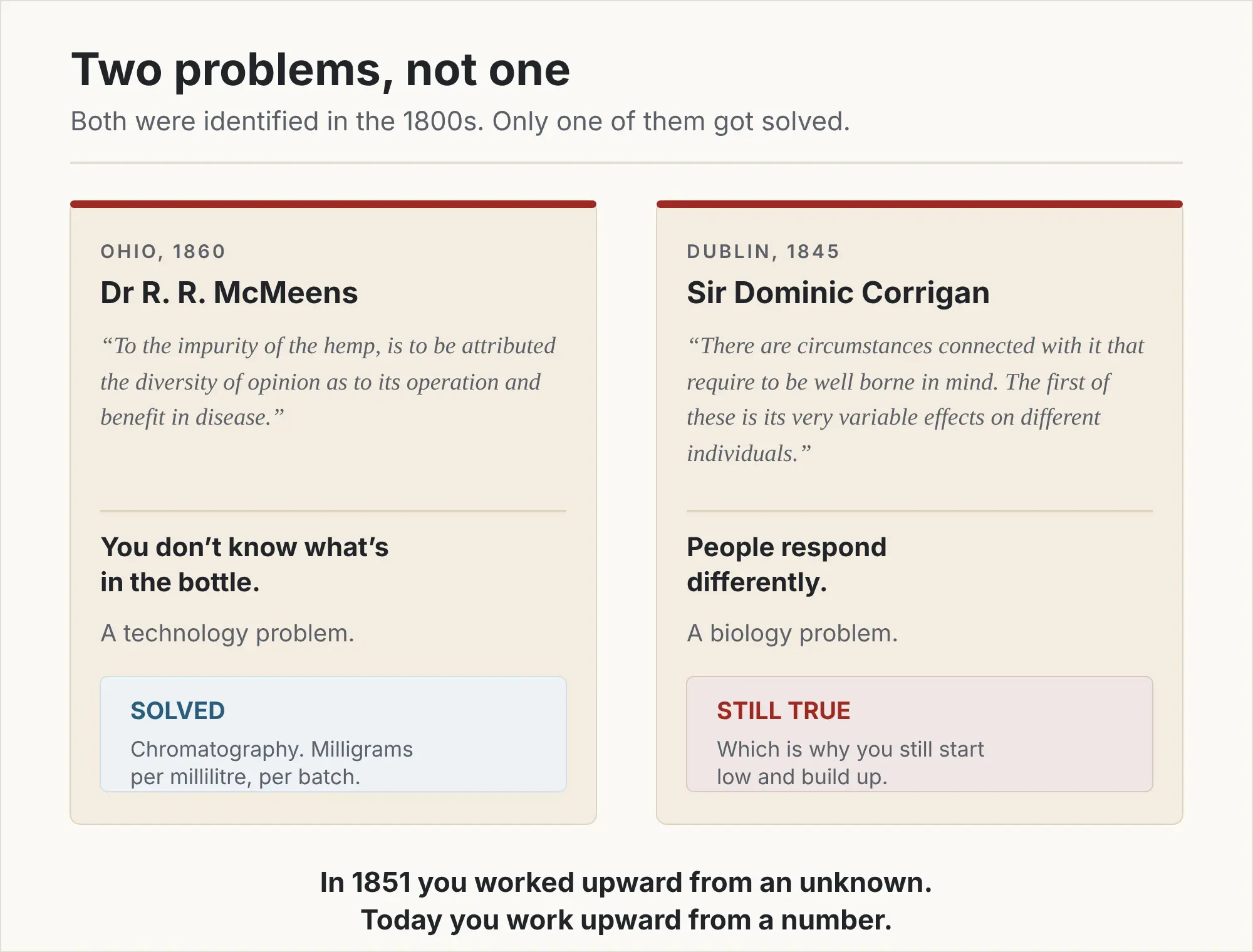
Put those together and you get the real change:
In 1851 you titrated from an unknown. Today you titrate from a number.
That sounds like a small distinction. It is the difference between finding a dose and being able to repeat it.
If you work upward from an unmeasured tincture and find the point where it helps, you have learned something about that bottle and nothing transferable. Next bottle, different parcel, start again — which is exactly what Buckingham was complaining about in 1860.
If you work upward from a measured milligram figure and find where you land, you know a number. That number stays true when the bottle runs out.
7. Knowing Your Number
Which makes the practical advice short.
Don’t think in percentages. A percentage describes a concentration, not an amount, and it’s the figure most easily made to sound impressive. Think in milligrams — per serving, and per bottle. That is what a laboratory reports and what a certificate of analysis will show.
Check that the certificate matches the batch code on the bottle in your hand, and check its date. A certificate for a different batch, or a two-year-old one, tells you very little.
And once you know where you land, write it down. That number is yours and it travels.
Strength then becomes a practical question rather than a marketing one. A stronger oil is not a better oil — it is more milligrams in the same millilitre. The only thing it changes is how many drops it takes to reach the number you already know you want.
For some people that is the whole appeal: fewer drops, less often, same amount. For others a lower strength is perfectly sensible. Neither is a virtue.
It is simply arithmetic — which is precisely the thing Donovan, Corrigan, Buckingham and McMeens never had.
This Week: Our Two Highest-Strength Oils
We’re running buy-one-get-one-free on our two strongest CBD oils this week.
20% CBD Oil — [X]mg per [X]ml bottle
30% CBD Oil — [X]mg per [X]ml bottle
Both stated in milligrams, because that’s the figure that means something. The batch certificate for each is linked on the product page — check it against the batch code on the bottle when it arrives.
See the offer — ends [DATE].
This is a history article about pharmacy and dosing practice. It describes how cannabis preparations were measured and prescribed in the past. Nothing in it is evidence that any modern product works, historical medical use is not a claim about any product sold today, and nothing here is dosing advice. Dr. Hemp Me products are food supplements and are not intended to treat, cure or prevent any condition. If you take medication or have a health condition, talk to your doctor or pharmacist before using any supplement.
Glossary
Titration — finding the right amount by starting low and increasing in steps, observing as you go.
Minim — one-sixtieth of a fluid drachm, roughly 0.06 ml. Defined as about one drop of water, though alcoholic drops are smaller.
Grain — 64.8 mg. Used for solid extracts.
Tincture — a dilute alcoholic preparation, typically a tenth the strength of a fluid extract.
Fluid extract — the most concentrated liquid preparation: one gram of dried plant per millilitre of finished liquid.
Pharmacopoeia / Dispensatory — the official references setting what each preparation must contain and how it should be dosed.
HPLC — high-performance liquid chromatography. Separates the compounds in a sample and reports each as a measured quantity.
Certificate of analysis (COA) — a laboratory report for one specific batch, listing what was measured and how much was found.
More in This Series
- What was actually in a bottle of cannabis medicine? — the 1912 label, taken apart phrase by phrase.
- William Brooke O’Shaughnessy — the Limerick doctor who brought cannabis into Western medicine.
- The history of hemp in Ireland — not Celtic, and not what you’ve been told.
- The Indian Hemp Drugs Commission, 1893–94 — the most thorough cannabis inquiry of its age, and how it was ignored.
- When did cannabis become illegal in Ireland? — how a normal pharmacy medicine quietly disappeared.
Sources
- United States Dispensatory, 1918 — entries on Tincture and Fluidextract of Cannabis: dose ranges, the titration instruction, the note that the tincture was about 33% weaker than the 1890 preparation, and the statement that commercial variability made it impossible to assign a proper dose.
- Michael Donovan, “Observations on the resin of Indian hemp”, Dublin Medical Press 25(637):182–183 (1851), p. 183 — the titration protocol.
- Michael Donovan, Dublin Journal of Medical Science 26:368–402 (1845), p. 381 — on weak local preparations and his own self-experiment.
- Dominic Corrigan, “Cases of chorea and tic-doloureux”, Dublin Hospital Gazette 10:143–145 (1845), p. 144 — on variable effects between individuals.
- R. R. McMeens, Report of the Ohio State Medical Committee on Cannabis Indica (1860) — on impurity as the source of disagreement, and the prescribing practices of Buckingham, Dalton and Fronmueller.
- Ethan Russo, “History of Cannabis as Medicine: Nineteenth Century Irish Physicians and Correlations of Their Observations to Modern Research” (2017) — the modern scholarly source for the Donovan and Corrigan quotations and their page references.
- W. B. O’Shaughnessy, On the Preparations of the Indian Hemp, or Gunjah (Calcutta, 1839).
Frequently Asked Questions
How was cannabis dosed before it could be measured?
By titration. References gave a wide permitted range and instructed the prescriber to start at the low end and increase gradually until an effect appeared. The 1918 US Dispensatory gave the tincture dose as ten to thirty minims, “to be gradually increased until some effects are experienced.”
Why couldn’t they just state a dose?
Because the strength of each batch was unknown. Cannabidiol was not isolated until 1940 and THC not until 1964, so there was no way to measure the active content of a preparation. Without a known strength, a fixed dose would have been meaningless.
What is a minim?
One-sixtieth of a fluid drachm, about 0.06 ml, defined as roughly one drop of water. Because alcoholic liquids form smaller drops, “drops” and “minims” were not interchangeable in practice — a further source of imprecision.
Who first wrote down the start-low-and-increase approach?
It appears in several places, but one of the clearest early statements is Michael Donovan’s, in the Dublin Medical Press in 1851: begin with a small dose and slowly increase it night, noon and morning until the pain gives way, or until it is clear that it will not.
Did the official strength of cannabis preparations really change?
Yes. The US Dispensatory records that the tincture of its day was about 33 per cent weaker than the 1890 version — a change in the official standard itself, not in any individual batch.
Is “start low and build up” still the right advice?
It remains the standard approach, for the reason Corrigan gave in 1845: people respond differently to the same preparation. What has changed is the starting point. Today you can begin from a measured milligram figure on a batch certificate rather than from an unknown.
Should I think in percentages or milligrams?
Milligrams. A percentage describes concentration; milligrams describe the amount you are actually taking. A certificate of analysis reports milligrams, so that is the figure that can be checked.