Skip to content
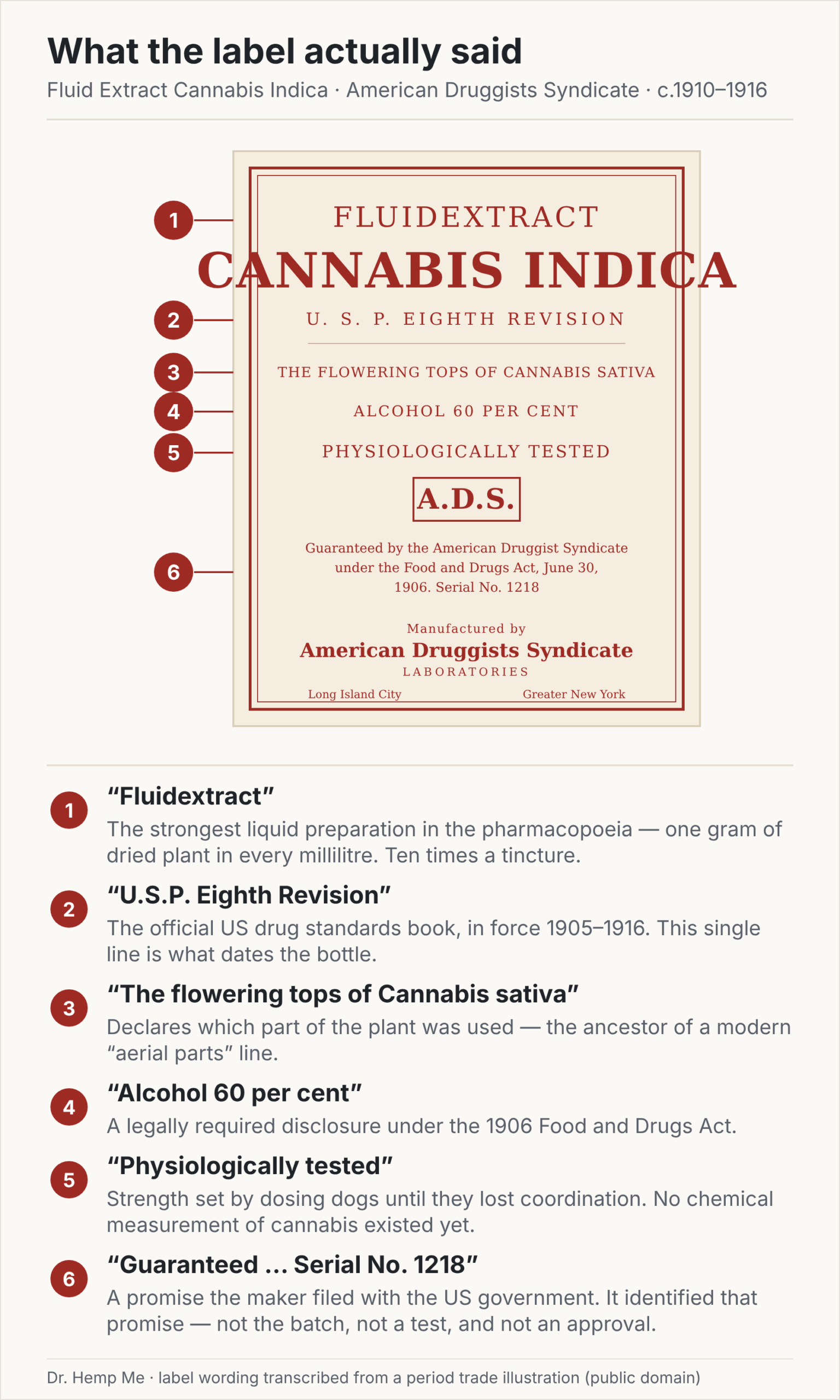
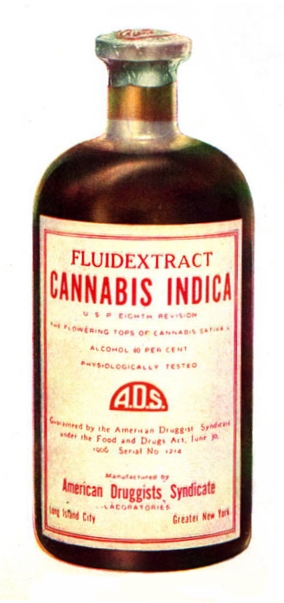
There is a brown glass bottle, photographed in museum collections, with a label that reads Cannabis Indica. Underneath, in smaller type: Fluid Extract. Physiologically Tested. And along the bottom edge: Guaranteed under the Food and Drugs Act, June 30, 1906.
It was made by the American Druggists Syndicate, a co-operative of retail chemists that manufactured its own goods in Long Island City, and it dates to somewhere around 1910 to 1916.
Most people look at a bottle like that and see a curiosity. A bit of Victorian strangeness.
We looked at the label and saw a set of promises.
Every phrase on it was doing a job. Each one was a claim about identity, strength, or honesty — the same three claims a bottle of CBD oil makes on a shelf in Ireland today.
So this article takes the label apart, phrase by phrase, and asks a simple question of each one: what did it actually mean, and how does it compare to what we can do now?
Some of the answers are flattering to the present day.
One of them isn’t.
1. The Bottle: What It Was and When It Was Made
Start with the dating, because the label dates itself.
The phrase Guaranteed under the Food and Drugs Act, June 30, 1906 could not appear before mid-1906, when the US Pure Food and Drugs Act was passed. That is the floor.
The ceiling comes from the pharmacopoeial standard. The label names the USP eighth revision, which was the official American drug standards book from 1905 until the ninth revision replaced it on 1 September 1916. That is the ceiling.
So: c.1910–1916, give or take.
Which is worth pausing on, because of what it isn’t.
William Brooke O’Shaughnessy, the Limerick doctor who introduced cannabis to Western medicine, published his Calcutta trials in 1839 and died in 1889. This bottle was filled roughly seventy years after his paper, and twenty-odd years after his death.
It is not his bottle. It is the industry his work created, three generations on — mass-produced, federally regulated, and sold by catalogue.
What a “fluid extract” was
A fluid extract was the most concentrated liquid preparation in the pharmacopoeia. The standard was one part by weight of crude drug to one part by volume of finished extract — so one gram of dried herb yielded one millilitre of extract.
A tincture was far weaker, typically a tenth of that strength. Fluid extracts were the professional-strength preparation: a pharmacist diluted them to make up a prescription.
The solvent was alcohol, usually with water. Cannabis resins do not dissolve in water, so alcohol did the work — the same reason modern extraction uses ethanol or CO₂ rather than water.
And the 1906 Act required the alcohol percentage to be declared on the label. That was one of its central provisions: a list of named substances, alcohol among them, had to be disclosed if present. This label declares 60 per cent.
So a customer in 1912 could read the alcohol content off the bottle.
That is a disclosure requirement most food supplements in Europe still don’t carry.
2. “Physiologically Tested” — They Tested It on Dogs
This is the phrase that stops people.
Here is why it was there.
In 1912, nobody could measure what was in cannabis. Cannabidiol was not isolated until 1940. THC was not characterised until 1964. There was no chromatography, no mass spectrometry, no way to put a number on a bottle’s contents.
But cannabis strength varied enormously between harvests — Irish and British pharmacists had been complaining about exactly that since the 1840s. A bottle you couldn’t measure was a bottle you couldn’t dose.
So the industry measured the effect instead.
In 1908, two Parke-Davis pharmacologists, Houghton and Hamilton, published a method for standardising cannabis by giving it to dogs and observing the dose at which the animals became unsteady on their feet. Loss of coordination was the endpoint. It was visible, it was gradual, and it was reproducible enough to compare one batch against another.
By 1916, this was the official standard. The United States Pharmacopoeia ninth revision required that fluid extract of cannabis produce incoordination when administered to dogs in a dose of not more than 0.03 mil per kilogramme of body weight.
Read that again. The specification was not a percentage of anything. It was a dose at which a dog should wobble.
The procedure
The published method is unexpectedly precise about everything except the chemistry.
Fox terriers were preferred — small, consistent in size, and familiar enough with the handler that nervousness wouldn’t be mistaken for drug effect.
Two dogs per assay, because one animal’s reaction proved nothing.
Fasted for twenty-four hours beforehand, so stomach contents wouldn’t slow absorption unpredictably.
Tested in a quiet room, each dog separated, because an excited dog looks like an affected dog.
Observed by the same person throughout, since the whole measurement was a judgement call about when an animal became unsteady.
Three days’ rest between tests on the same animal, because tolerance built up and a tolerant dog would make a strong batch look weak.
Every one of those details exists to control a variable in a test whose instrument was an animal’s gait. The dogs were kept, rested and tested again — which is precisely why tolerance was a problem the method had to work around.
No laboratory would be permitted to do this now, and that is the right outcome.
What the profession thought of it
They were not satisfied. That’s the part worth knowing.
The United States Dispensatory of 1918 — the standard reference of the day — said the assay gave the preparation a certain indefinite amount of physiological action, and concluded that it was impossible to assign the proper dose.
That is a profession writing down, in its own flagship reference book, that its best available standard wasn’t good enough.
They used it anyway, because it was all they had.
What replaced it
High-performance liquid chromatography.
Put a sample through an HPLC column and the cannabinoids separate out by how fast they travel. The detector reports each one as a number, in milligrams per millilitre, with the measurement repeatable to a fraction of a per cent.
A certificate of analysis from a modern lab will list CBD, CBDA, THC and a string of minor cannabinoids, each with a figure beside it, against a stated limit of detection.
The dog is replaced by a column and a detector.
And that — not the plant, not the extraction, not the fact of people using cannabis — is the genuine change across the century. The plant is the same plant. What changed is that we can finally see inside the bottle.
3. “Guaranteed Under the Food and Drugs Act” — What Was Actually Guaranteed
This phrase was the most misunderstood thing on the label, and it was misunderstood at the time too.
It reads like a government endorsement. It wasn’t.
Under Section 9 of the 1906 Act, a manufacturer could file a general statement — a guaranty — with the US Department of Agriculture, promising that its goods were not adulterated or misbranded. The Department issued a serial number in return. The manufacturer then printed that number on its labels. On this bottle it is Serial No. 1218.
What the number identified was the filed promise. Not the batch. Not a test result. Not an inspection.
Nobody from the government had opened that bottle.
The guaranty’s real function was legal: it shifted liability. If goods turned out to be adulterated, the guarantor, not the retailer who sold them, carried the can.
People in the trade saw the problem immediately.
John Uri Lloyd, one of the most respected pharmaceutical manufacturers in America, complained publicly in 1912 that the phrase was being used as advertising — that customers read it as official approval of quality when it certified nothing of the kind.
The Department of Agriculture agreed with him eventually. It amended the regulations between 1914 and 1916, precisely because the wording was being used to imply an endorsement that didn’t exist.
If you want a historical parallel for the modern CBD shelf, this is the one.
Not the product. The label language.
A phrase borrowed from a regulatory process, printed in a way that invites the customer to read approval into it.
That pattern is a hundred and ten years old.
4. “Increase Until the Desired Effect Is Produced”
Dosing instructions from the period have a particular shape, and once you notice it you can’t unsee it.
Eli Lilly’s own handbook for physicians advised, for cannabis preparations, starting low and increasing the dose until the desired effect was produced.
That is not a dose. It is an instruction to find the dose by trial, on the patient.
And it followed directly from the measurement problem. If you cannot know a batch’s strength to better than “a certain indefinite amount of physiological action”, you cannot print a number. You can only tell the prescriber to titrate.
Irish pharmacy knew this earlier than most.
Michael Donovan, of the Apothecaries’ Hall in Dublin, published on Indian hemp in the Dublin Journal of Medical Science in 1845 and reported that the preparations available to him were weak and inconsistent. Writing again in 1851, he concluded that the only prudent course was to begin with a small dose and increase it slowly. Sir Dominic Corrigan, publishing in the same decade, warned of the drug’s “very variable effects on different individuals”.
Within six years of O’Shaughnessy’s paper reaching Europe, Dublin physicians had identified the exact problem that would still be unsolved seventy years later when that bottle was filled.
The modern version of the instruction has not disappeared, incidentally. “Start low and build up” is still standard advice with CBD, and honest brands say so.
The difference is that now it starts from a known quantity. You titrate from a measured milligram figure, not from an unknown.
5. The Uncomfortable Part
All of the above makes a tidy story about progress. Here is where it stops being tidy.
Having the measurement technology is not the same as using it honestly.
In February 2020, the Food Safety Authority of Ireland published results from testing CBD products on sale here. Of the products examined, 41% contained less than half the CBD stated on the label.
Not slightly off. Less than half.
Ireland was not an outlier.
A study published in JAMA in 2017 tested CBD products sold online and found that around seven in ten were inaccurately labelled, in both directions.
A UK study published in 2023 tested 63 products and found just five whose CBD content came within 10% of the label claim.
Five out of sixty-three.
So set the two eras beside each other properly.
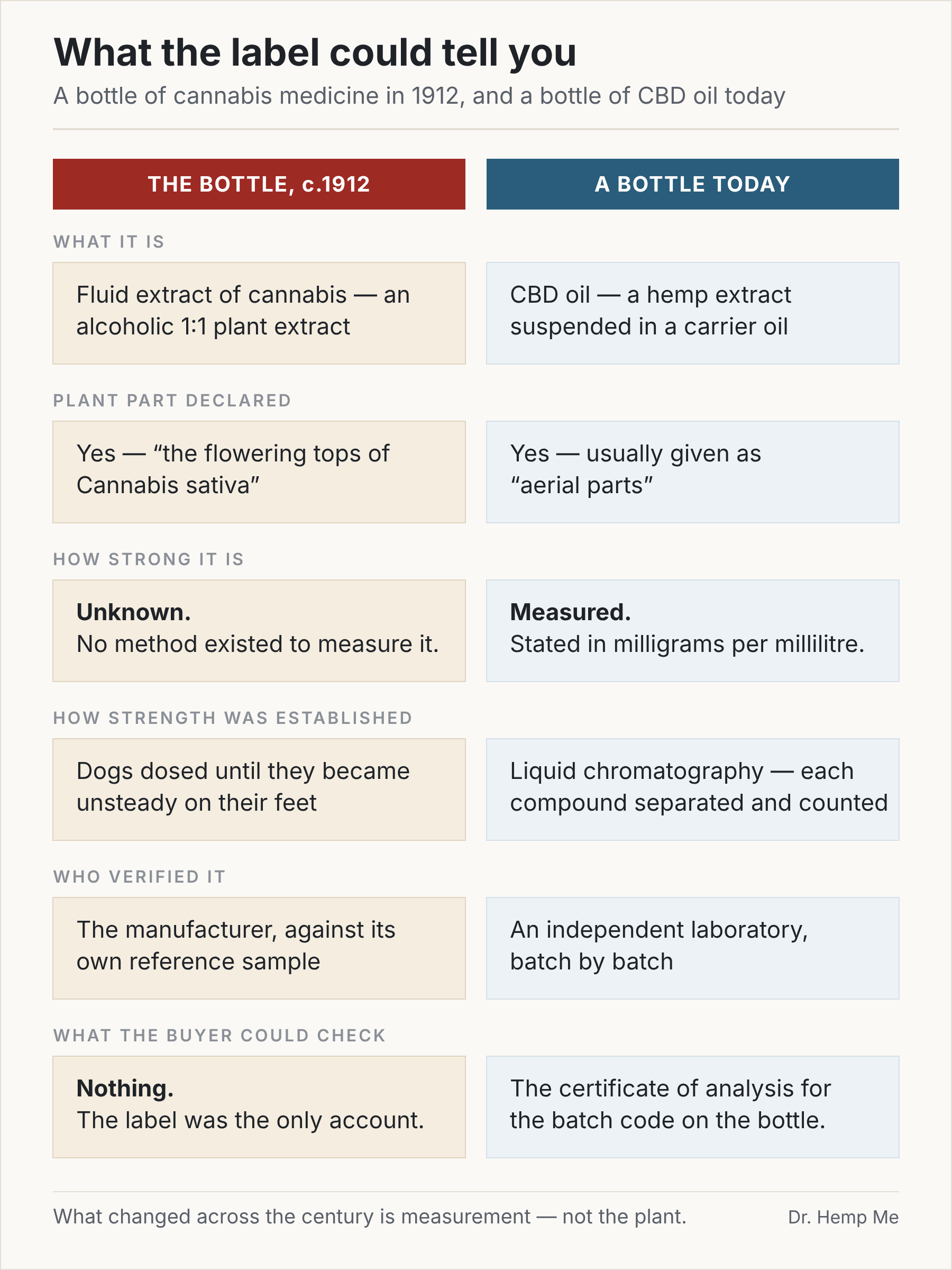
The 1912 manufacturer could not measure what was in the bottle. The method was an animal’s gait, the profession admitted it was inadequate, and the label said so in its own way — physiologically tested is a claim about effect, not content, and it was honest about being that.
The 2020 manufacturer could measure it to a fraction of a milligram. Some of them printed a number anyway that bore no relation to what was inside.
That is a worse failure than 1912’s, not a better one. It isn’t a limit of the science. It’s a choice.
Which is why a certificate of analysis matters more than any phrase on a label, and why we publish batch results. A number on a bottle is a claim. A number on a third-party lab report, matched to the batch code on the bottle in your hand, is a verifiable fact.
That is the one genuine advantage the present has over 1912.
It only counts if somebody uses it.
Glossary
Fluid extract — the most concentrated liquid preparation in the old pharmacopoeias: one part by weight of dried plant to one part by volume of finished liquid.
Tincture — an alcoholic preparation, typically a tenth the strength of a fluid extract.
Physiological assay (bioassay) — measuring a preparation’s strength by the effect it produces in a living animal, used when chemical measurement was impossible.
Pharmacopoeia — the official reference setting legal standards for medicines: what each preparation must contain and how it must be tested.
Guaranty (1906 Act) — a statement filed with the US Department of Agriculture promising goods were not adulterated or misbranded. It shifted legal liability; it was not a test or an approval.
HPLC — high-performance liquid chromatography. The modern method: separates compounds in a sample and reports each as a measured quantity.
Certificate of analysis (COA) — a laboratory report for a specific batch, listing what was measured and how much of it was found.
Sources and Further Reading
- United States Pharmacopoeia, eighth and ninth revisions (1905, 1916) — pharmacopoeial standards for cannabis preparations, including the dog assay specification.
- Houghton and Hamilton, American Journal of Pharmacy, 1908 — the published physiological assay method for cannabis.
- United States Dispensatory, 1918 — contemporary professional assessment of the assay’s limitations.
- Pure Food and Drugs Act 1906, Section 9, and USDA regulations as amended 1914–1916 — the guaranty provisions.
- John Uri Lloyd, 1912 — contemporary criticism of guaranty wording in advertising.
- Michael Donovan, Dublin Journal of Medical Science, 1845, and Dublin Medical Press, 1851 — on the variability of Indian hemp preparations available in Dublin.
- Dominic Corrigan, Dublin Hospital Gazette, 1845 — on variable effects between individuals.
- Food Safety Authority of Ireland, February 2020 — survey of CBD products on sale in Ireland.
- JAMA, 2017 — labelling accuracy of CBD products sold online.
- Johnson et al., Journal of Cannabis Research, 2023 — CBD content versus label claim in 63 UK products.
This is a history article about pharmacy and regulation. It describes how cannabis preparations were made, measured and labelled in the past. Nothing in it is evidence that any modern product works, and historical medical use is not a claim about any product sold today. Dr. Hemp Me products are food supplements and are not intended to treat, cure or prevent any condition.
Frequently Asked Questions
What was in a bottle of cannabis medicine in 1912?
An alcoholic fluid extract of cannabis: one part dried plant by weight to one part finished liquid by volume, with the alcohol percentage declared on the label as the 1906 Act required. What nobody knew was the cannabinoid content, because no method existed to measure it.
What does “physiologically tested” mean on an old medicine label?
That the preparation’s strength had been checked by its effect on a living animal rather than by chemical analysis. For cannabis, the test was the dose at which dogs lost coordination.
Why did they test cannabis medicine on dogs?
Because chemical measurement was impossible. Cannabidiol was not isolated until 1940 and THC not until 1964. Batch strength varied enormously, so the industry measured the effect instead of the content. By 1916 the United States Pharmacopoeia specified incoordination in dogs at a dose of not more than 0.03 mil per kilogramme of body weight.
Did “Guaranteed under the Food and Drugs Act” mean the government approved it?
No. A manufacturer filed a general promise with the US Department of Agriculture that its goods were not adulterated or misbranded, and received a serial number to print. The number identified the filed promise, not any test of the bottle. Its practical effect was to shift legal liability away from retailers.
How is a modern CBD oil tested compared to 1912?
By high-performance liquid chromatography, which separates the cannabinoids in a sample and reports each as a measured quantity in milligrams per millilitre. The result is a certificate of analysis for a specific batch, where 1912 had an observation of a dog’s gait.
Are modern CBD products accurately labelled?
Often not. The Food Safety Authority of Ireland found in February 2020 that 41% of products tested contained less than half the CBD stated on the label. A 2017 JAMA study found around seven in ten products sold online were inaccurately labelled, and a 2023 UK study of 63 products found only five within 10% of their label claim. This is why a batch-matched certificate of analysis matters more than any label phrase.
Is the cannabis plant different now from the one in that bottle?
Cultivated varieties have changed, but the plant is the same species. The substantial change over the past century is in measurement: we can now say what is in an extract, which nobody in 1912 could do.