 Skip to content


Cannabizetol: The Newly Discovered Cannabinoid Hiding in Full-Spectrum Extracts
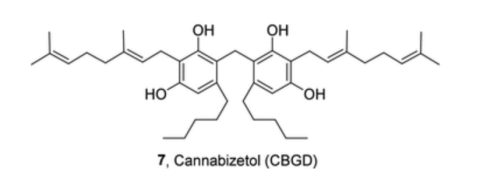
In September 2025, researchers at the University of Milano published something remarkable in the Journal of Natural Products. They discovered a cannabinoid that’s been hiding in cannabis plants all along. Cannabizetol. The third known “dimeric cannabinoid” ever found. So rare—under 0.1% of plant material—that it took specialized extraction and synthesis just to identify it. But here’s what made me sit up and take notice: When they tested it against inflammation in human skin cells, cannabizetol downregulated 17 inflammatory genes. Its parent molecule, CBG, only downregulated 2. Not twice the effect. Not even five times. Nearly nine times more genes affected. This matters for anyone using full-spectrum CBD oils. Because cannabizetol is almost certainly in there. In trace amounts. Contributing to effects we attribute to other cannabinoids. In this article, I’ll break down: Let’s dive in. What Is Cannabizetol? Chemical name: Cannabizetol (abbreviated as CBGD, which stands for CBG Dimer) Structure: Two cannabigerol (CBG) molecules linked together by a methylene bridge (-CH2-) Class: Methylene-bridged dimeric cannabinoid (extremely rare) Discovery: First isolated and fully characterized in 2025 Concentration: Under 0.1% of plant material (approximately 0.02-0.06%) Understanding Dimers Simply Imagine two LEGO blocks clicking together. Each block—let’s say it’s CBG—has certain properties. It fits certain spaces. It connects certain ways. But when you click two blocks together with a connecting piece (the methylene bridge), the new structure has entirely different properties than either block alone. It’s bigger. It has a different shape. It connects to things the single blocks couldn’t reach. That’s what happens with cannabizetol. Two CBG molecules link together through a single carbon atom. That simple connection changes everything about how the molecule behaves. The Other Known Dimers Cannabizetol isn’t the first dimeric cannabinoid discovered. It’s the third: All three share the same basic structure: two cannabinoid molecules holding hands through a methylene bridge. Why So Rare? Dimeric cannabinoids are incredibly rare for several reasons: Low natural concentrations: They form in tiny amounts—under 0.1% of plant material. That means in 1000mg of cannabinoids, maybe 1mg is cannabizetol. Difficult to isolate: Extracting and purifying something present at 0.02% requires sophisticated equipment and techniques. Not routinely tested: Standard cannabinoid testing panels screen for 10-15 major cannabinoids. Dimers aren’t on the list. Labs don’t even have reference standards for them. Only recently characterized: We didn’t know what to look for. Scientists needed to synthesize cannabizetol first, characterize its structure, then go back to plant extracts to confirm it exists naturally. How Do They Form? Dimers can form through several pathways: If you could see cannabizetol at the molecular level, it would look like two CBG molecules holding hands through a single carbon atom. That’s the methylene bridge. One carbon. But it changes everything. The Anti-Inflammatory Research The University of Milano team didn’t just discover cannabizetol. They tested it. They wanted to know: does this dimer have biological activity? And how does it compare to its parent molecule (CBG) and the other known dimer (cannabitwinol)? The Study Setup Cell type: HaCaT cells (human keratinocytes – skin cells) Why skin cells? These are the most widely used model for studying skin inflammation. They’re involved in conditions like acne, eczema, and psoriasis. Comparison: They tested three compounds side-by-side: Focus: Inflammatory pathways relevant to skin conditions Let me walk you through what they found. Finding #1: IL-8 Inhibition IL-8 is an inflammatory marker that recruits immune cells to sites of inflammation. When you have acne, eczema, psoriasis, or general skin irritation, IL-8 levels go up. The researchers induced inflammation with TNFα (a pro-inflammatory signal), then treated cells with cannabizetol. The results: At 1 μM concentration: 30% reduction in IL-8 At 5 μM concentration: Complete elimination of IL-8 release Not reduced. Not suppressed. Completely shut down. The IC50 (concentration that inhibits 50% of the response) was 1.46 μM for cannabizetol. For comparison, cannabitwinol (the CBD dimer) had an IC50 of 6.39 μM. Cannabizetol is 4.4 times more potent than cannabitwinol at shutting down IL-8. Finding #2: NF-κB Inhibition NF-κB is the master switch for inflammation. Think of it like the control panel for your home’s electrical system. Flip the main breaker, and everything downstream turns off. NF-κB controls hundreds of inflammatory genes. When it’s activated, those genes turn on. When it’s inhibited, they stay quiet. Cannabizetol inhibited NF-κB activation with an IC50 of 4.95 μM. Cannabitwinol needed 19.8 μM to achieve the same effect. Cannabizetol is 4 times more potent at shutting down the master inflammation switch. Finding #3: Gene Expression Analysis (The Most Impressive) This is where cannabizetol really surprised the researchers—and me. They ran a gene expression array testing 84 inflammatory genes. These genes control everything from cytokine production to immune cell recruitment to tissue damage. They treated cells with TNFα to induce inflammation. Then they added either: Results with CBG: Only 2 genes were downregulated significantly (CCL5 and CCL2) Results with cannabizetol: 17 genes were downregulated significantly Let that sink in. The dimer affected 8.5 times more genes than its parent molecule. Which genes were affected? Some of the most important ones: This isn’t just suppressing one pathway. Cannabizetol affects multiple inflammatory pathways simultaneously. A multi-target approach. Exactly what you want for complex inflammatory conditions. Finding #4: Antioxidant Activity Beyond anti-inflammatory effects, cannabizetol showed “remarkable antioxidant” activity. Higher than cannabitwinol. Higher than expected. This is important because inflammation and oxidative stress often go hand-in-hand. Inflammatory conditions create oxidative damage. Oxidative damage drives more inflammation. It’s a vicious cycle. Cannabizetol addresses both problems at once. Safety Profile Zero cytotoxicity at all tested concentrations (0.5-20 μM). This is critical. Potent doesn’t mean toxic. Cannabizetol shuts down inflammation without harming cells. Why Dimers Are More Potent Than Parents Here’s what puzzled me when I first read this study: CBG is already anti-inflammatory. We know this. It’s been tested. So why is cannabizetol—literally two CBGs linked together—so much more potent? Shouldn’t it be about twice the effect? Instead, it’s affecting 8.5 times more genes. The Answer: New Molecular Architecture When two cannabinoid molecules link through a methylene bridge, you